Heat Sink
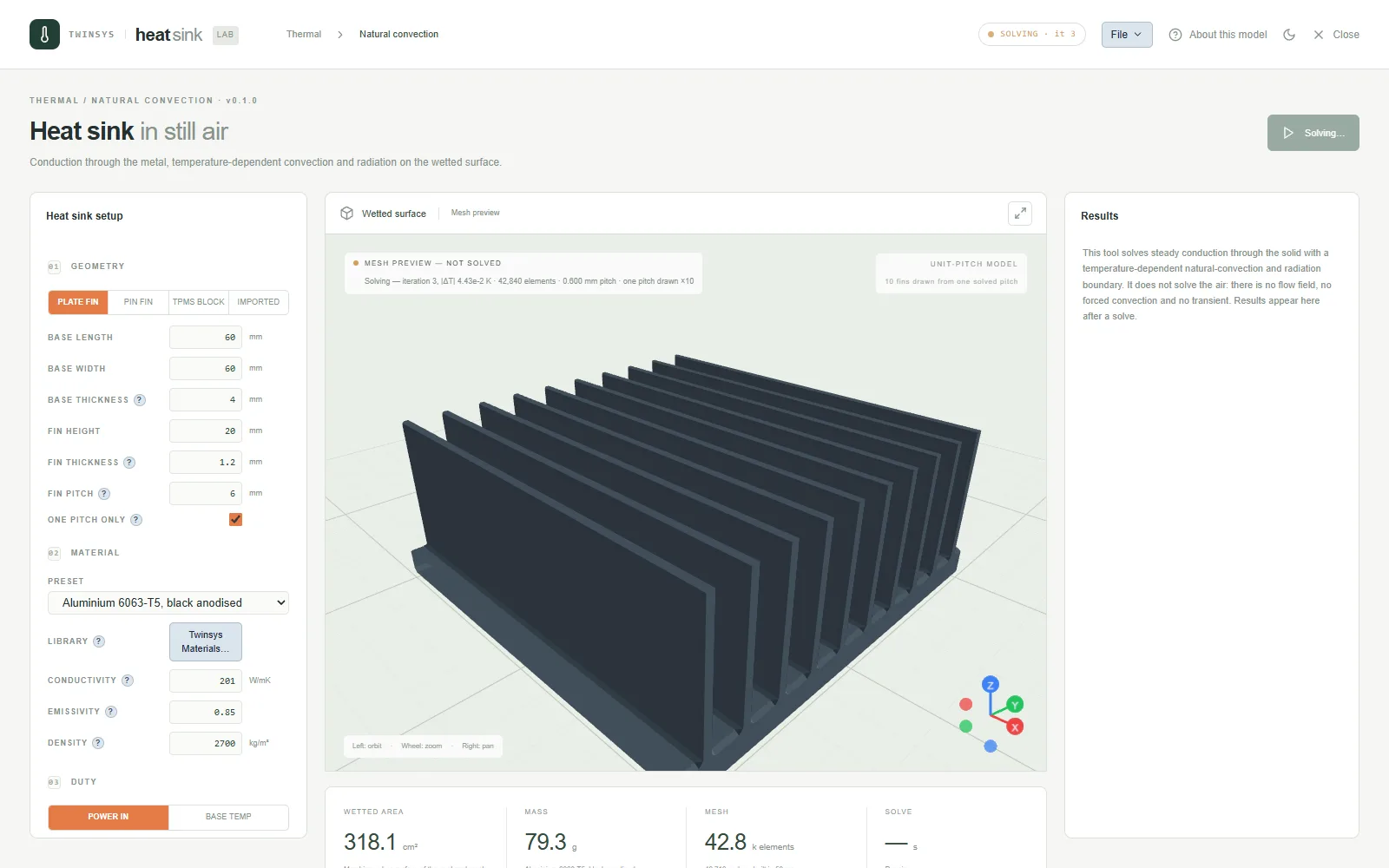
Predict how much heat a heat sink sheds in still air by natural convection and radiation, and find the fin pitch that works best.
Product pages are in English.
Highlights
- Plate fin, pin fin, TPMS or graded lattice block, or an imported STL or 3MF
- Conduction in the metal coupled to temperature-dependent convection and radiation
- Channel correlation captures the fin-pitch optimum, where more fins start to choke the flow
- Base temperature rise, thermal resistance at the solved power, and temperature on the surface
- Lists what the model does not know with every result; save inputs on your computer or cloud
A question it answers
How much heat can this sink dump in still air, and what fin pitch should I actually use?What you put in
Geometry type and dimensions (base length, width and plate thickness; fin height, thickness and pitch; pin diameter and array; lattice cell size and wall thickness; or an imported mesh with an explicit UNIT and up-axis declaration); material and surface emissivity; ambient air temperature and radiant sky temperature; orientation; element budget; and the duty as either a power into the base or a prescribed base temperature. A measured convection coefficient can be entered to override the correlation.
What you get
Base temperature rise, hottest point, thermal resistance quoted at the power it was solved at, convection and radiation split, surface efficiency, mass, wetted area with a breakdown per surface class, temperature and film-coefficient fields painted on the surface, energy balance residual, achieved mesh statistics, and a closed-form optimum fin spacing evaluated for the temperature rise actually reached. A standing section listing what this model does not know is shown with every result.
More in this family
Ice Cream Line
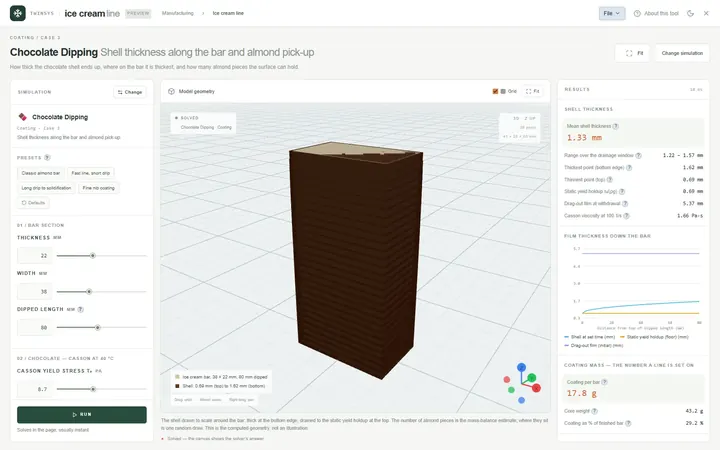
PremiumModel a frozen-dessert line case by case: freezing time, hardening tunnel, chocolate dipping, extrusion, coating, toppings, cornet line.
DEM
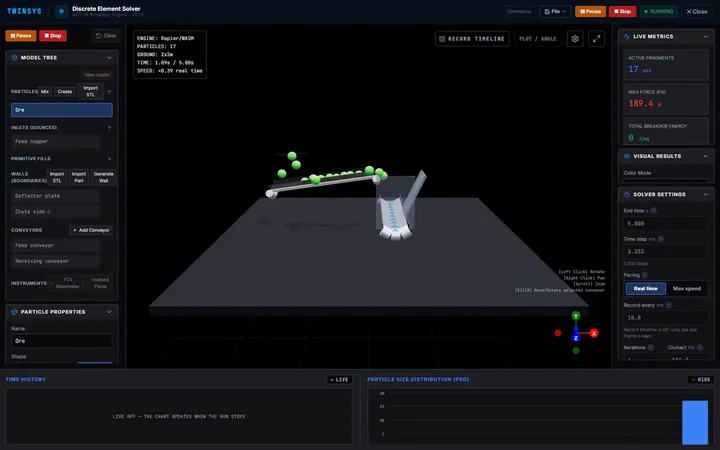
PremiumSimulate bulk material in transfer chutes, conveyors and screens with the discrete element method, and calibrate it with built-in tests.
SPH Fluid Bench
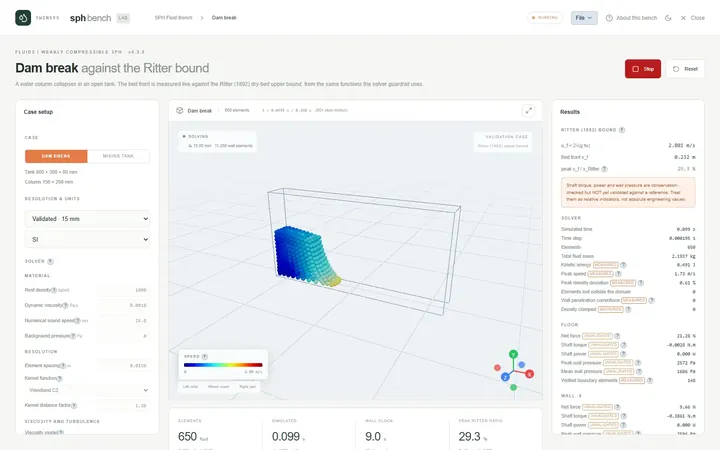
PremiumWatch a weakly-compressible SPH fluid solver run a dam break checked against Ritter's solution, and a stirred mixing tank.
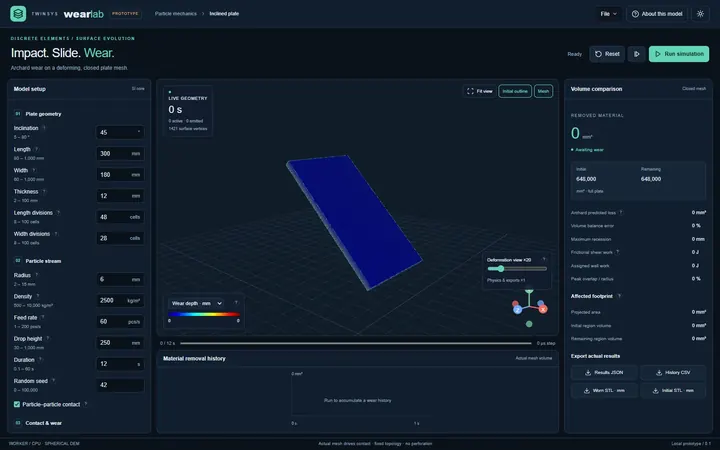
DEM - Wearing
PremiumSimulate particles sliding down an inclined plate and wearing it by Archard's law, with the worn surface fed back into contact.