ShellFEA
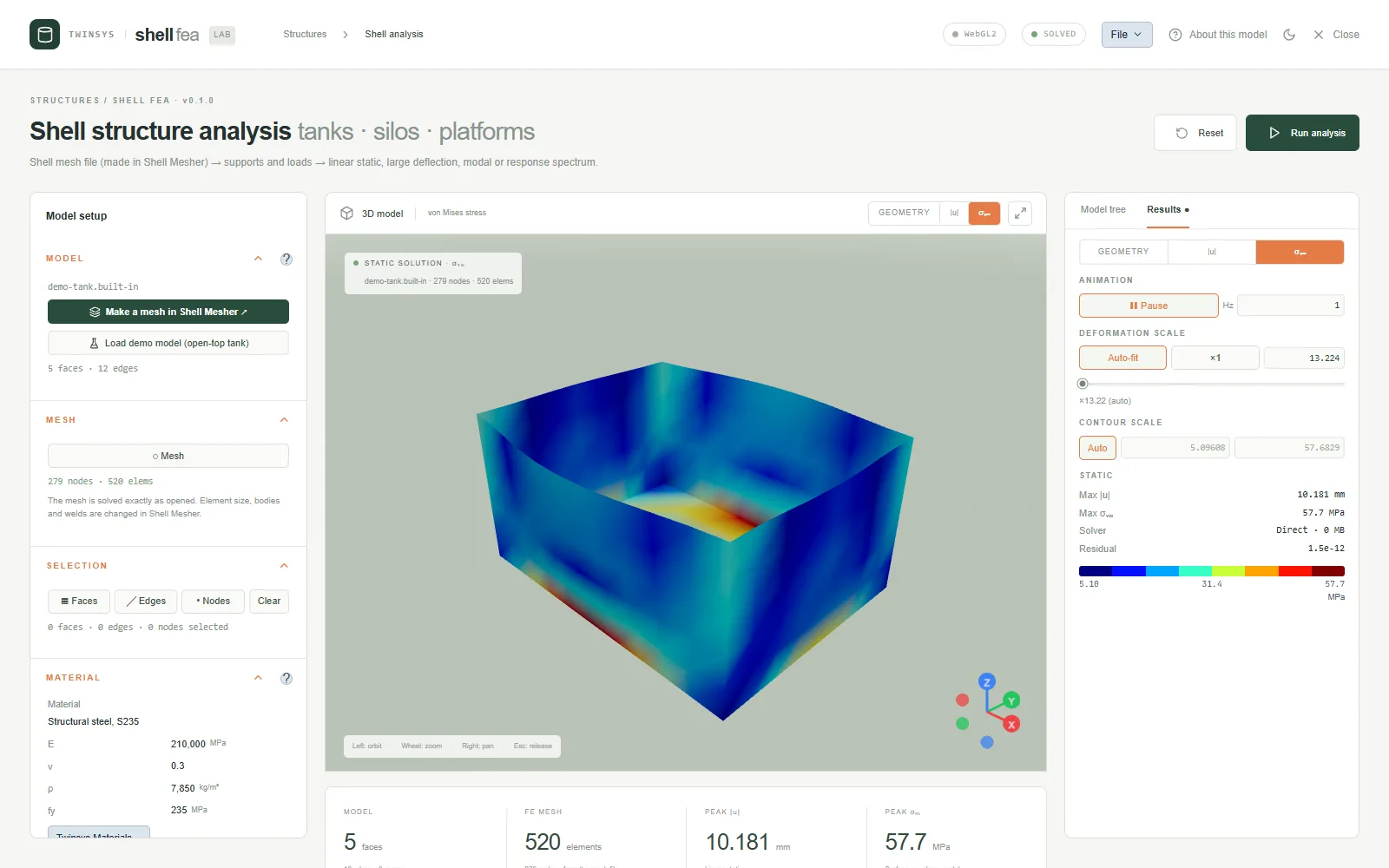
Finite element analysis of welded steel tanks, silos and platforms from a shell mesh: static, large deflection, modal and seismic spectrum.
Product pages are in English.
Highlights
- Opens the mesh made in Shell Mesher and solves it exactly as saved; thickness and material stay editable
- Supports and loads on named selections stay bound to them when Shell Mesher sends an updated mesh
- Pressure, self-weight, hydrostatic head and wind to TS EN 1991-1-4; seismic to TBDY 2018 or Eurocode 8
- A direct sparse solver by default, 5 to 20 times faster on shells; large deflection past a limit point
- Through-thickness stress envelopes, seam utilisation and an independent check of every mode list
A question it answers
Does this tank shell pass under hydrostatic pressure plus the site's seismic spectrum, and what forces are the seams carrying?What you put in
A shell mesh file from Shell Mesher (or the sample tank); supports and loads on picked faces, edges or nodes or on the mesh's named selections — pressure, self-weight, hydrostatic head, wind to TS EN 1991-1-4 and forces on nodes; a seismic spectrum to TBDY 2018 or Eurocode 8 Type 1 with site class, spectral parameters and R, D and I; the analysis type and its settings, including the solver (direct or iterative) and, for a large-deflection run, load control or arc-length, the number of steps and whether pressure follows the deformed surface.
What you get
Displacement and stress contours with the through-thickness surface envelope (membrane plus and minus bending), deformed shape, natural frequencies with animated mode shapes, spectral response combined by CQC or SRSS with directional combination, seam utilisation ratios and the solver that ran; for a large-deflection run, the load–displacement curve against the linear answer, a step slider through the converged steps and the stability past a limit point; a line that says whether an independent count confirms the list of natural frequencies; and the meshed model sent on to Eigenvalue Buckling.
More in this family
Air Tank Cover
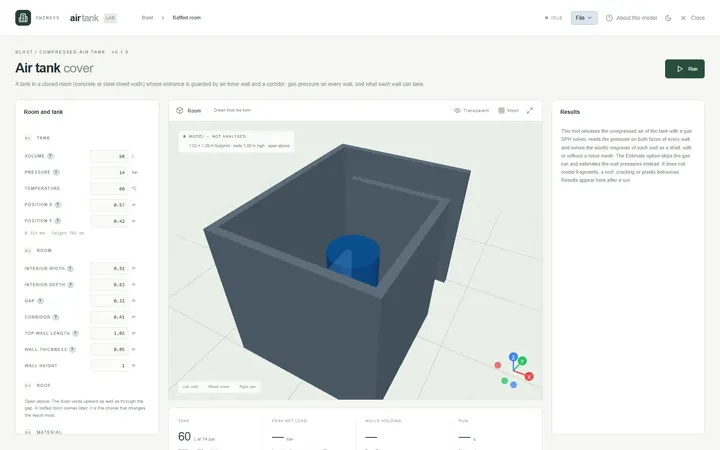
PremiumCheck the concrete or steel walls of a room around a compressed-air tank against the blast load if the tank releases its air.
Freezer Room
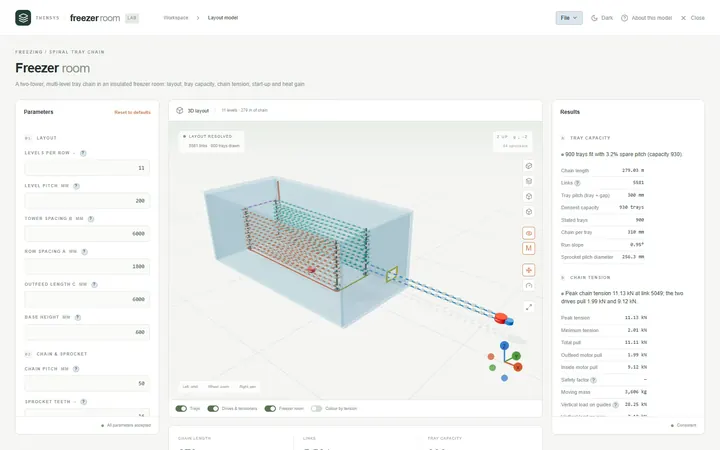
PremiumLay out a two-tower spiral tray chain in an insulated freezer room and check tray capacity, link tension, start-up and heat gain.
Bracket Designer
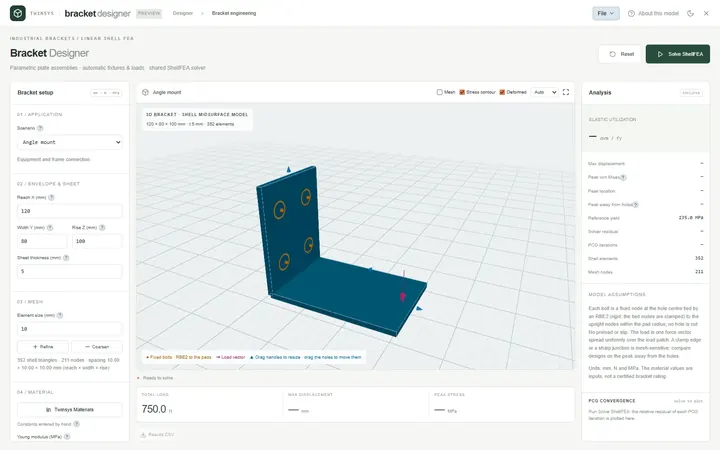
PremiumSize angle, shelf, gusseted and offset sheet-metal brackets with a linear elastic shell FEA that sets up its own wall bolts and load.
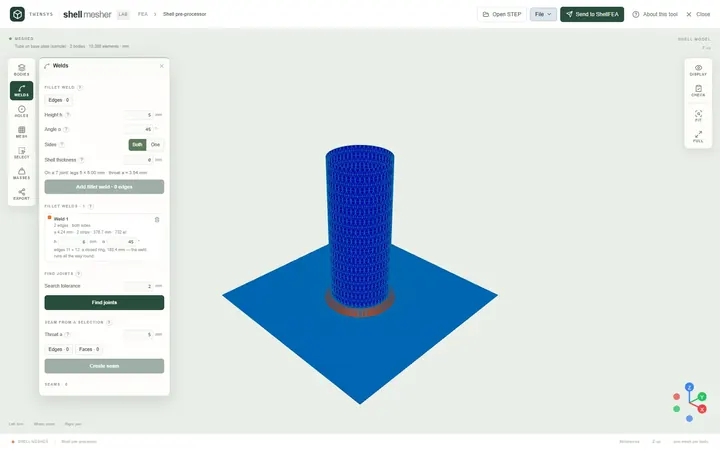
Shell Mesher
Free accountMesh STEP sheet bodies for shell analysis in the browser: thickness and element size per body, bolts in holes, fillet welds, one mesh file.
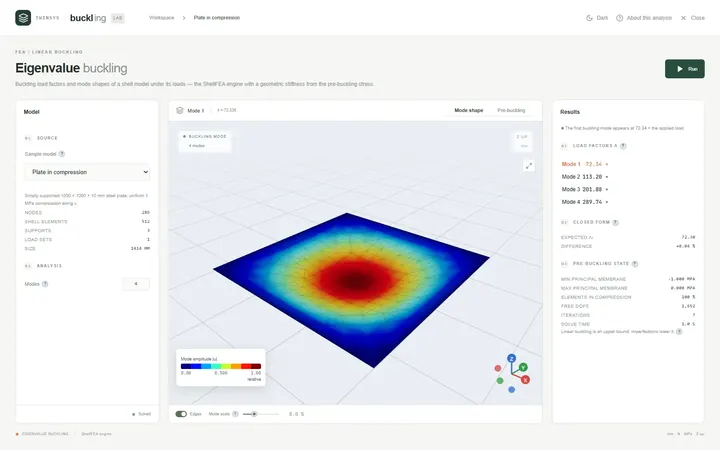
Eigenvalue Buckling
PremiumFind the load factors at which a shell structure buckles and see each buckling mode shape, from a ShellFEA model or a sample.
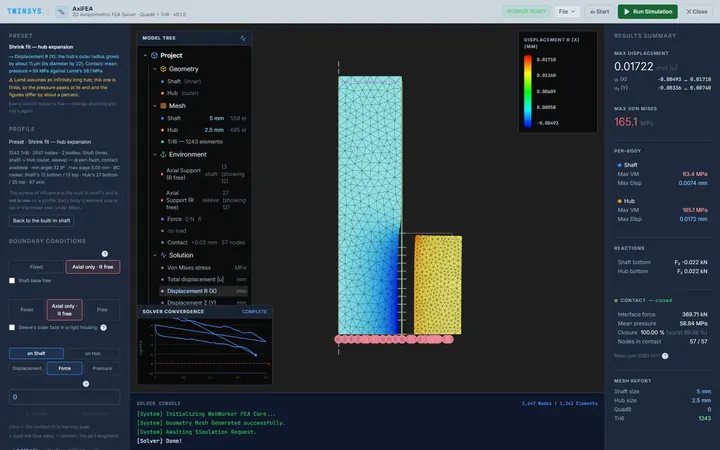
AxiFEA
PremiumAxisymmetric stress analysis of shafts, hubs, shrink fits and seals, with contact and friction, solved in your browser.