Silo
steel silo designer on the ShellFEA engine
Design and check a steel silo on a shell FEA model: wall courses, hopper, roof, product, wind and seismic loads, legs and anchor bolts.
Product pages are in English.

Highlights
- Circular or polygonal plan, wall courses, conical hopper, roof, and a skirt or braced legs
- Janssen, steep-hopper, discharge and patch loads for stored solids, or hydrostatic liquid loads
- Analytic shell buckling per course, leg and bracing checks, base plates, anchor bolts and foundation
- Large deflection (GNA) of the governing combination, with second-order moments in members flagged
- PDF, XLSX and Markdown report; save inputs on your computer or in your cloud
A question it answers
Can a 6 m wheat silo with 8/6/5 mm courses stand on eight X-braced legs, and which governs — shell buckling above the legs, the legs, the bracing or the anchor bolts?What you put in
Plan shape and diameter, reference surface, wall courses (height, thickness, optional corrugation), hopper (half angle, outlet, thickness), roof, skirt or legs (count, tube, length, base fixity, panels, X / single / no diagonals, bracing tube, buckling curve), ring beam, vertical stiffeners, openings; material from the Twinsys library; stored product or liquid, fill level, load cases (self weight, filling, discharge, wind, seismic), editable combinations, partial factors and fabrication class, mesh; anchor bolts (count, size, bolt circle, base plate, embedment, concrete class); for a large-deflection run, the load combination, load control or arc-length, the number of load steps and the load factor λ.
What you get
3D shell (geometry, stress, displacement, deformed, section cut, exploded assembly, stored product) with legs, bracing, base plates, bolts and foundation; per-combination summary, ring-by-ring segments, stiffener and support-member tables with utilisation, analytic shell buckling per course, stress profile, geometry audit, support reactions, anchorage table, verdicts; mesh convergence study; PDF, XLSX and Markdown report; project JSON; and a large-deflection (GNA) run of one combination: whether the load factor was reached with a stable final state, the load–displacement curve against the linear response, and every member group's force and moment against its linear value.
More in this family
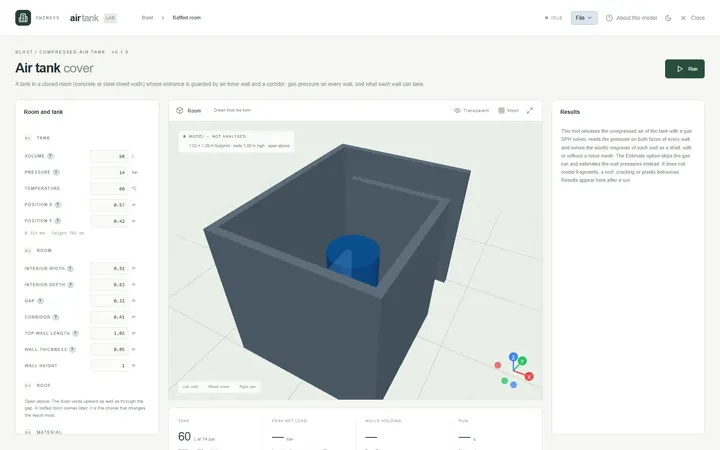
Air Tank Cover
PremiumCheck the concrete or steel walls of a room around a compressed-air tank against the blast load if the tank releases its air.
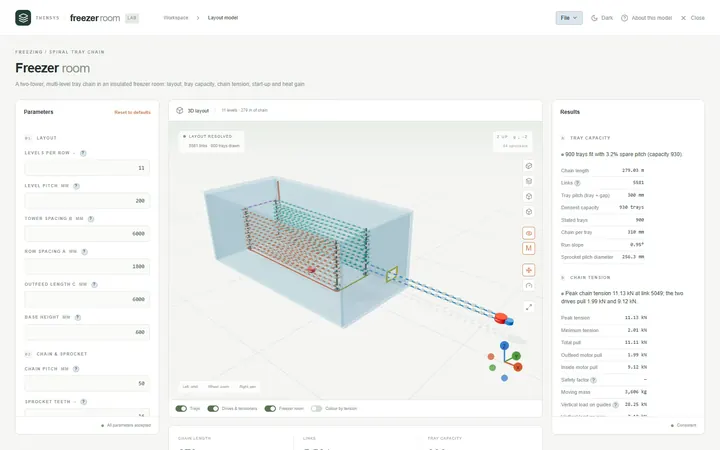
Freezer Room
PremiumLay out a two-tower spiral tray chain in an insulated freezer room and check tray capacity, link tension, start-up and heat gain.
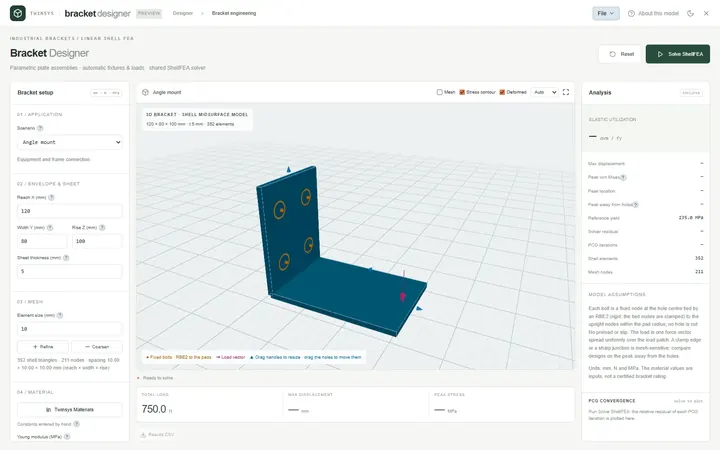
Bracket Designer
PremiumSize angle, shelf, gusseted and offset sheet-metal brackets with a linear elastic shell FEA that sets up its own wall bolts and load.
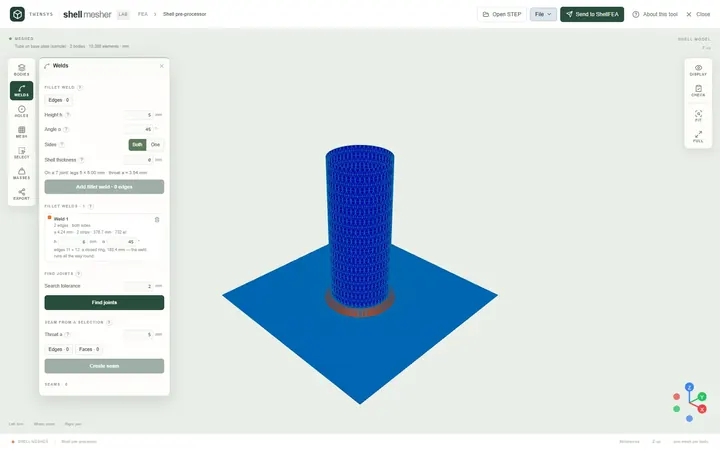
Shell Mesher
Free accountMesh STEP sheet bodies for shell analysis in the browser: thickness and element size per body, bolts in holes, fillet welds, one mesh file.
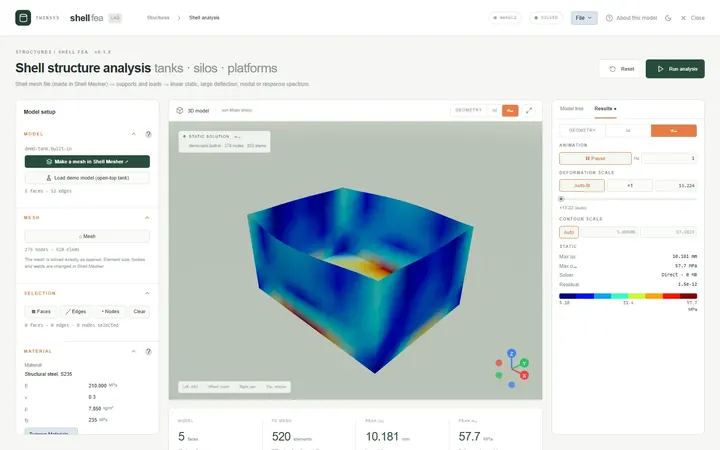
ShellFEA
PremiumFinite element analysis of welded steel tanks, silos and platforms from a shell mesh: static, large deflection, modal and seismic spectrum.
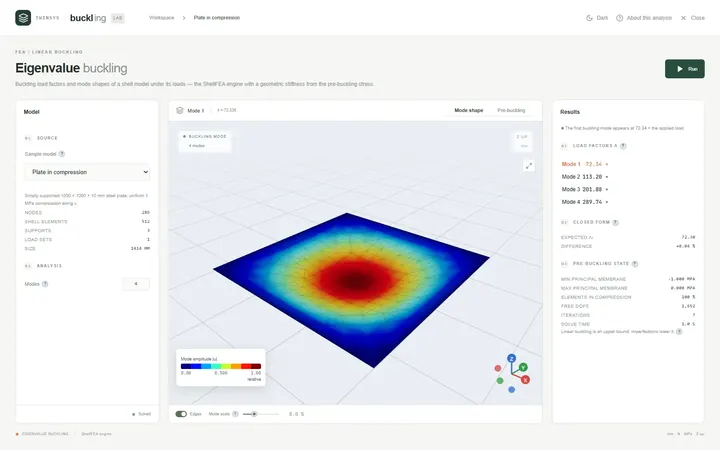
Eigenvalue Buckling
PremiumFind the load factors at which a shell structure buckles and see each buckling mode shape, from a ShellFEA model or a sample.